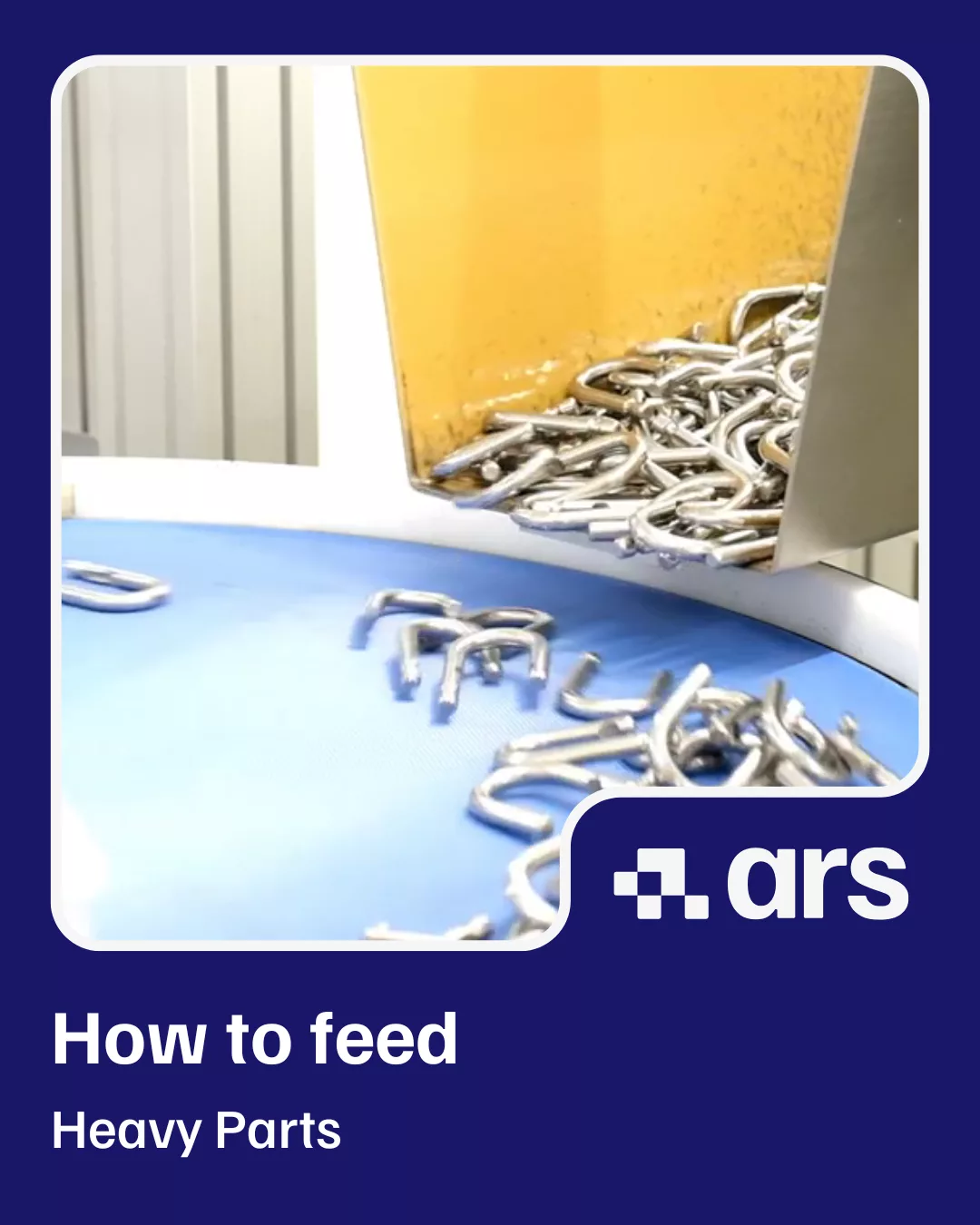
How to feed heavy parts
In automated assembly lines, a lot of attention is placed on robots, cycle time and vision systems. However, when dealing with heavy metal components, the feeding system often becomes the true bottleneck of the process.
Parts such as large brass fittings, steel connectors, valves, flanges or machined blocks introduce challenges that cannot be underestimated. Their weight, combined with complex geometries, significantly impacts the stability, reliability and efficiency of the feeding phase.
Why traditional systems reach their limits with heavy components
Traditional feeding systems can be an option when handling lightweight parts with simple geometries.
However, when parts become heavier and more complex, several critical aspects emerge:
- High inertia, making controlled movement more difficult
- Unstable part orientation, especially with asymmetrical or multi-axis geometries
- Noise and vibrations, often amplified by the mass of the components
- Limited adaptability, particularly when product variants or frequent changeovers are required
In these scenarios, feeding is no longer just a supporting function—it directly affects uptime, productivity and overall system reliability.
How flexible feeding systems address these challenges
Flexible feeding systems take a different, more adaptive approach. Instead of forcing parts through fixed mechanical paths, they rely on controlled motion combined with vision guidance to manage orientation and presentation.
For heavy parts, this approach offers clear advantages:
- Smoother, more controlled handling, even with high part mass
- Effective management of complex geometries, without dedicated tooling
- Fast reconfiguration, supporting multiple part types on the same line
When flexible feeding systems are combined with vibratory or motorized hoppers, the result is a constant and reliable supply of heavy components to the feeder. This upstream buffering ncreases system autonomy, prevents interruptions, stabilizes the flow of parts and allows the system to maintain performance even in demanding, high-load applications.
This makes flexible feeding particularly attractive for system integrators and machine builders who need scalable, future-proof solutions.
Discover our applications in this dedicated playlist.
The added value of FlexiBowl® for heavy parts
When it comes to feeding large and heavy components, FlexiBowl® 1200 is designed to operate exactly in this demanding space.
Key advantages include:
- Large feeding surface, ideal for bulky and heavy parts
- Combined rotational and impulse motion, ensuring stability and precise control
- Flexibility, even with complex part geometries
- Seamless integration with vision systems, enabling reliable robotic pick-up
- Compatibility with industrial robots and cobots, regardless of brand
The result is a feeding solution that maintains performance and repeatability where weight would otherwise become a limiting factor.
Applications across multiple industries
Although often associated with high-volume manufacturing, heavy-part feeding is critical in many sectors, including:
- Automotive and mobility
- Hydraulics and pneumatics
- Industrial machinery
- Mechanical and metalworking industries
In all these contexts, flexibility translates into simpler system design, shorter commissioning times and higher long-term efficiency.
Feeding is not a detail — it’s a strategic choice
For system integrators, it means greater design freedom.
For machine builders, a single system adaptable to different customers.
For end users, a more robust and future-ready production line.
When heavy parts are involved, feeding technology plays a decisive role. Choosing the right approach can make the difference between a system that merely works and one that truly performs.