In industrial automation, “compact layout” is often treated as a secondary constraint—something to optimize once the process is proven. In practice, footprint is a primary engineering variable. Each of us working in industrial environments has seen projects where performance targets were met in concept, but commissioning and long-term stability suffered because the cell became mechanically crowded, difficult to access, and hard to maintain.
A compact layout is not just about saving floor space. It affects cycle stability, maintainability, safety, integration effort, and overall equipment effectiveness (OEE).
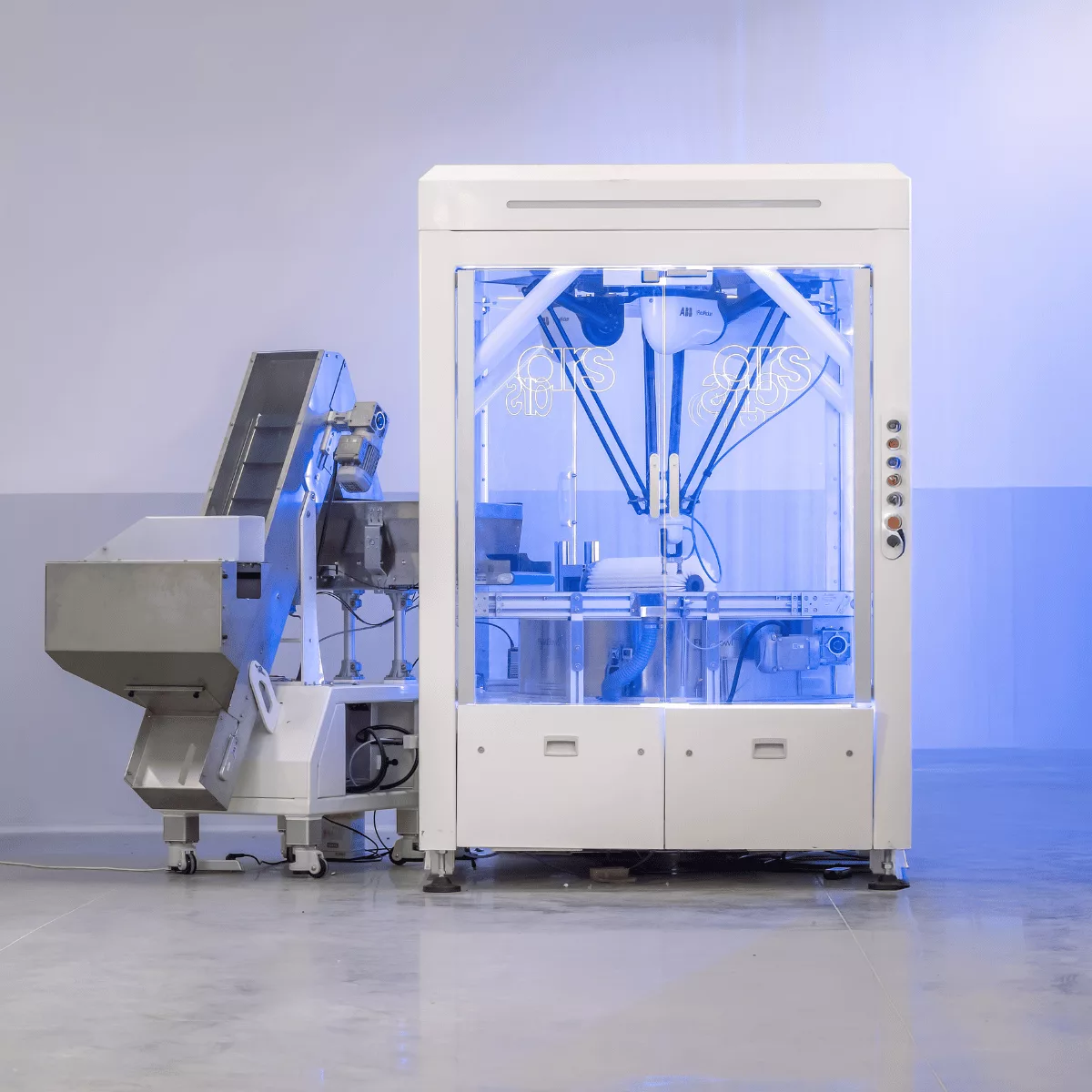
1) Why compactness matters
1.1 Access and maintainability
As the cell grows, so do:
- cable routing complexity
- tool and gripper access constraints
- ease of cleaning and inspection
- time required for interventions (unplanned stops, adjustments, preventive maintenance)
In real production, the ability to perform a fast, safe intervention often has a bigger impact on uptime than marginal gains in peak throughput.
1.2 Reduced mechanical interactions and “layout-driven” failure modes
Crowded layouts increase the probability of:
- collisions during robot recovery moves
- interferences between feeders, guarding, and gripper trajectories
- vibration coupling between structures
- difficult-to-control lighting and reflections for vision systems
A compact cell is easier to engineer into a stable mechanical system with fewer unknowns.
1.3 Shorter travel distances and more predictable robot motion
Pick-and-place time is strongly influenced by travel distance and acceleration profiles. A compact arrangement can:
- reduce the robot’s average travel path
- improve motion repeatability
- decrease cycle time variance (less “jitter” from long moves, fewer dynamic effects)
This is particularly relevant when the cycle must remain stable across shifts and operators.
1.4 Safety and ergonomics
More equipment usually means more guarding, more access gates, more safety zones, and more potential points where human interaction becomes risky or inefficient. Compactness often enables cleaner safety design and more intuitive operator access.
2) Where footprint is lost: typical causes in feeding-and-vision cells
In flexible feeding applications, footprint tends to expand due to:
- multiple dedicated feeding devices (each with its own pre-feeding, control, and sensors)
- separate control hardware distributed across the cell
- long conveyor runs introduced to create buffers and “make space”
- vision setup constraints (camera positioning, lighting isolation, reflection control)
- operator access requirements that are solved by “spacing out” rather than by design
The result is often a cell that is functional but not optimized for long-term production reality.

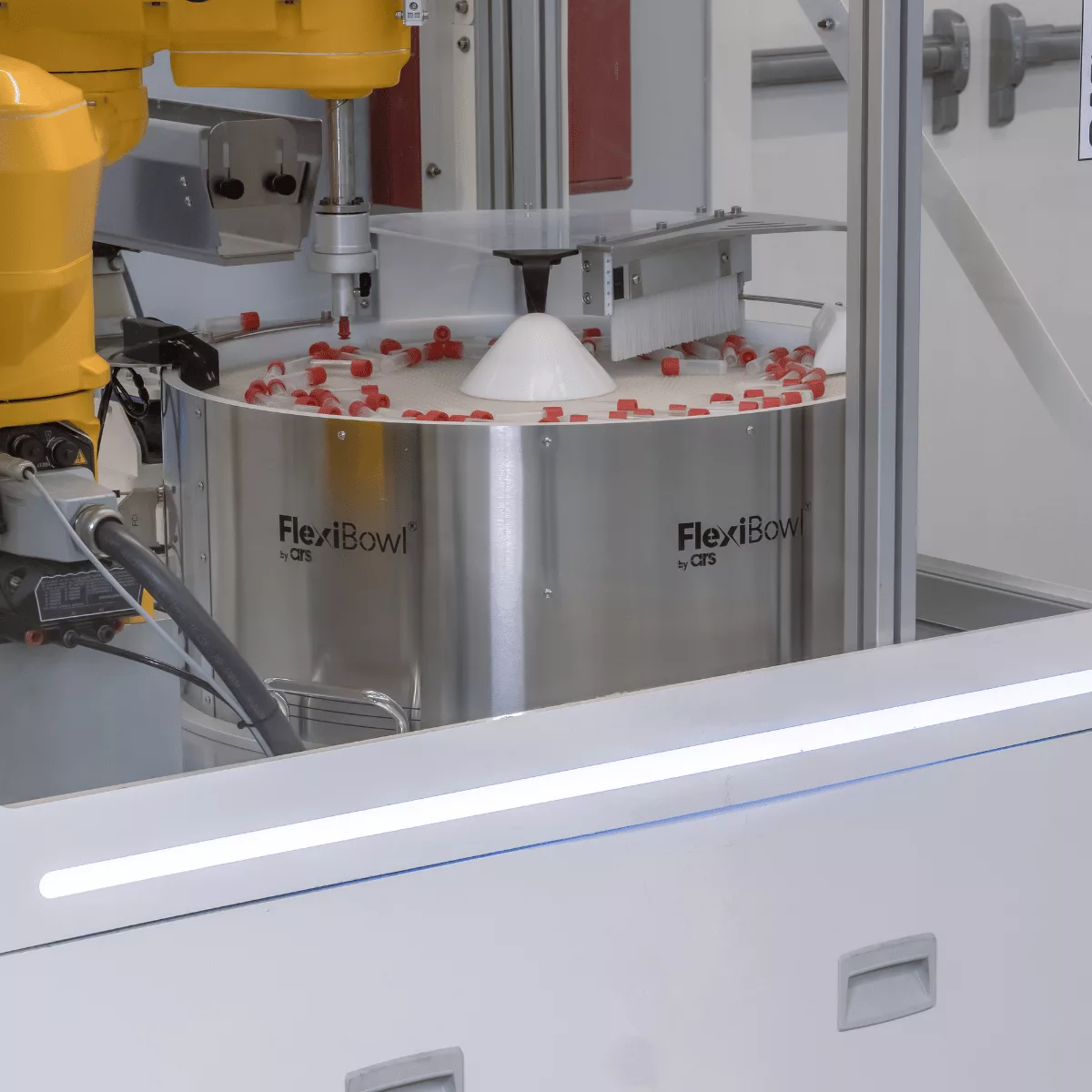
3) How FlexiBowl supports a compact cell architecture
FlexiBowl is designed as a feeding platform that can reduce footprint not by “compressing everything,” but by simplifying the feeding process and the integration structure.
3.1 Circular operating logic: feeding designed around continuous availability
A key layout driver in many systems is the need for linear accumulation and separate zones to stage parts. FlexiBowl operates in a circular logic, supporting continuous distribution and availability on the same working surface. This typically reduces the need for additional mechanical staging areas.
3.2 Integration-friendly design: fewer external mechanisms to orient parts
Traditional feeding solutions often require dedicated mechanical tooling (tracks, escapements, blades) to enforce orientation, which increases both footprint and mechanical complexity. FlexiBowl relies on controlled motion + configurable surfaces and accessories, shifting complexity away from bulky mechanical fixtures.